History
History of the MSU Mass Spectrometry and Metabolomics Core (MSMC)
In 1968, Professors Charles Sweeley and Jack Holland of the MSU Department of Biochemistry created a facility for mass spectrometry. In 1973, the MSU/NIH Mass Spectrometry Facility was established with funding from the Research Resources program of the National Institutes of Health (NIH). With this funding, they purchased a PDP-11 computer and an Atlas CH-5 double-focusing high resolution fielddesorption mass spectrometer that allowed one to desorb and capture mass spectra of non-volatile compounds including peptides.
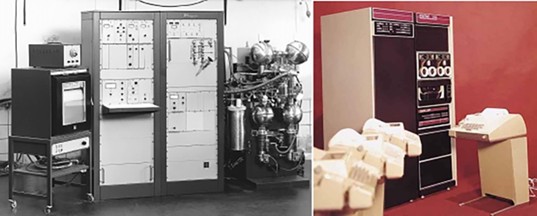
Atlas CH-5 mass spectrometer and DEC PDP-11 minicomputer (1973)
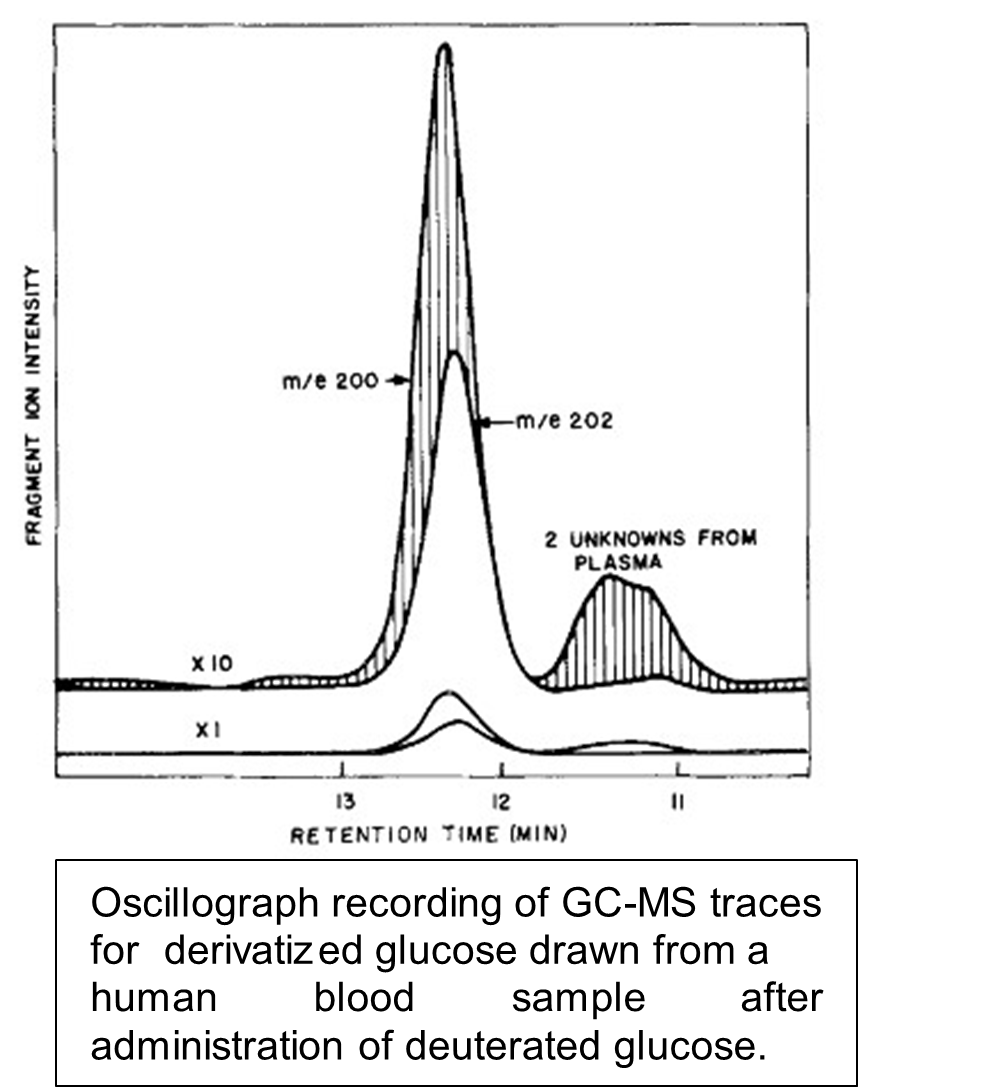
Sweeley and members of his laboratory were among the first to couple gas chromatography, a method for separating molecules, with mass spectrometry for analysis of substances in blood and urine. Their work led the development of strategies for analyzing steroids and carbohydrates using GC-MS and for characterization of glycosphingolipids. The Holland and Sweeley groups pioneered computer control of switching mass analyzers between specific masses, a technique now widely known as selected ion monitoring (SIM). In 1971, the facility generated the first mass spectrum of a chlorinated dioxin. In their 1975 paper in the Journal of Biological Chemistry, the Sweeley group reported dosing a human subject with glucose labeled with two atoms of deuterium, a heavy isotope of hydrogen, and analyzed the amounts of unlabeled (normal) and deuterated (heavy) glucose in the glycosphingolipids in the blood plasma. This was the first demonstration that mass spectrometry could be used to measure metabolism in humans, and the Sweeley group established a role for aberrant metabolism in the mechanism of Fabry disease.
In 1979, the Facility was moved to the basement of the Biochemistry Building. By this time, the MSU/NIH Mass Spectrometry Facility served as one of 4 or 5 Regional Mass Spectrometry Resources in the nation; it was used for analyzing samples for other scientists from all over the U.S. In 1980, Jack Throck Watson was recruited from Vanderbilt University to become Director of the Facility and Principal Investigator of the main NIH grant that funded the Facility. Professors Christie Enke and John Allison of the Department of Chemistry joined as co-directors in 1981. The facility investigators engaged in research to develop technology for acquiring mass spectra on the chromatographic time scale, as scan speeds of magnetic sector instruments were limited. This new theme promoted a renaissance of time-of-flight (TOF) mass spectrometry as applied to gas chromatography; through the electronics expertise of Professors Holland and Enke, an integrating transient recorder was developed in 1987 that allowed acquisition of up to 100 mass spectra per second compared to 2 mass spectra per second typical of mass spectrometers at the time. The rapid acquisition of mass spectra had a profound impact on the field of GC/MS by allowing the integrity of both the chromatography and the spectra to be preserved during the analysis of complex mixtures that could not be resolved by chromatography or mass spectrometry alone. The resulting new generation of GC/MS instrumentation based on TOF was first developed commercially by Meridian Instruments in Okemos, and eventually by LECO Instruments in Benton Harbor, Michigan.
In 1984, Charles Arntzen of the MSU/DOE Plant Research Laboratory and Jack Throck Watson, as co-PIs, obtained funding from DOE for a double-focusing magnetic sector mass spectrometer (JEOL HX110) equipped with a fast atom bombardment ion source to support budding efforts in protein characterization on the MSU campus. At that time, this $495,000 grant was the largest ever awarded to a University by DOE for instrumentation. This ‘work-horse’ instrument was in service until 2008.
During the mid-1980s, with assistance from Brian Musselman, Manager of the facility, Professor Watson developed a week-long ‘hands-on’ laboratory short course in mass spectrometry under the auspices of the American Chemical Society (ACS). This outreach program through the ACS not only extended mass spectrometry technology to hundreds of scientists and technicians throughout the country, but also provided in-depth advanced training for MSU graduate students, who served as teaching assistants for the short course. This emphasis on formal training in the arts and science of mass spectrometry combined with the research programs of the co-investigators led to the MSU/NIH-MSF becoming one of the pre-eminent training programs in mass spectrometry in the country (more than 80 Ph.D. students participated in fundamental research relating to mass spectrometry, mostly through the research groups of Watson, Allison, and Enke during the 1980s/90s).
In 1990, Dr. Doug Gage joined the MSU/NIH facility as Manager, and promoted collaborations with other biochemists on campus and throughout the country. Also at this time, a theme of core research changed to development of methodology for protein characterization using matrix-assisted laser desorption ionization (MALDI). Research in the Allison and Gage laboratories focused on a proteolytic approach to mass mapping phosphorylation sites in proteins, and the Watson laboratory focused on development of a novel chemical approach (cyanylation) for mapping of protein disulfides.
During the late 90s, NIH reduced support for the mass spectrometry Research Resource program because instruments had become widely available and need for centralized resources had ebbed. In 2001, Douglas Gage, then Assistant Professor of Biochemistry, secured substantial funding for new instrumentation to be used primarily for proteomics. The Mass Spectrometry Facility became part of the Genomic Technology Support Facility (later renamed Research Technology Support Facility or RTSF) in 2004, and the Facility was divided into separate Mass Spectrometry and Proteomics Cores.
In 2005, Dan Jones from Penn State University was appointed Professor of Biochemistry and Molecular Biology and Director of the Mass Spectrometry Facility, and Curtis Wilkerson assumed Directorship of the Proteomics Core. The operation of the “small-molecule” facility (now renamed as the Mass Spectrometry and Metabolomics Core) shifted from predominantly staff-run analyses to an open access model where students, postdocs, and staff were trained to operate the mass spectrometers and perform their own data analysis. This was facilitated by acquisition of LC/triple quadrupole, LC/QTof, and GC/quadrupole mass spectrometers and phase-out of magnetic sector instruments. Approximately 50 individuals per year were trained to operate Core mass spectrometers. Equipment grants from the National Science Foundation Major Research Instrumentation Program, Great Lakes Fishery Trust, and USDA-NIFA Equipment Grant programs plus contributions of equipment from faculty startup packages helped the Core expand to a resource of 12 mass spectrometers that serves the research of more than 130 principal investigators at MSU and about 25 from other institutions. Use of the Core grew by about 25% annually from 2005-2019. In 2023, the MSU Research Foundation provided funds to fully renovate the Core space in the basement of the Biochemistry building to update and modernize the facility (improved HVAC and ventilation control, new flooring and lighting, bulk nitrogen gas supply added). Funds were also provided to add additional equipment with capabilities for imaging mass spectrometry and high-resolution GC/MS.
In 2024 following the retirement of Dan Jones, Dr. Maryam Goudarzi joined the Biochemistry and Molecular Biology Department as Associate Professor and Director of the Mass Spectrometry and Metabolomics Core. Under Dr. Goudarzi’s leadership, the Core has continued to add new capabilities and develop our portfolio of offered services, particularly in the area of untargeted metabolomics and bioinformatics.